A cat’s coat can tell you something real about genetics: whether the cat is probably female, and in white cats, whether hearing is worth checking. It is a much weaker guide to personality. Studies that compare behavior by coat color are few, rely mostly on owners’ impressions and find small or inconsistent differences. Breed, early socialization and life experience shape a cat’s temperament far more than their colors.
Coat colors at a glance
“Tabby” and “calico” describe coat patterns, not breeds. The same pattern appears in many breeds and in mixed-breed cats.
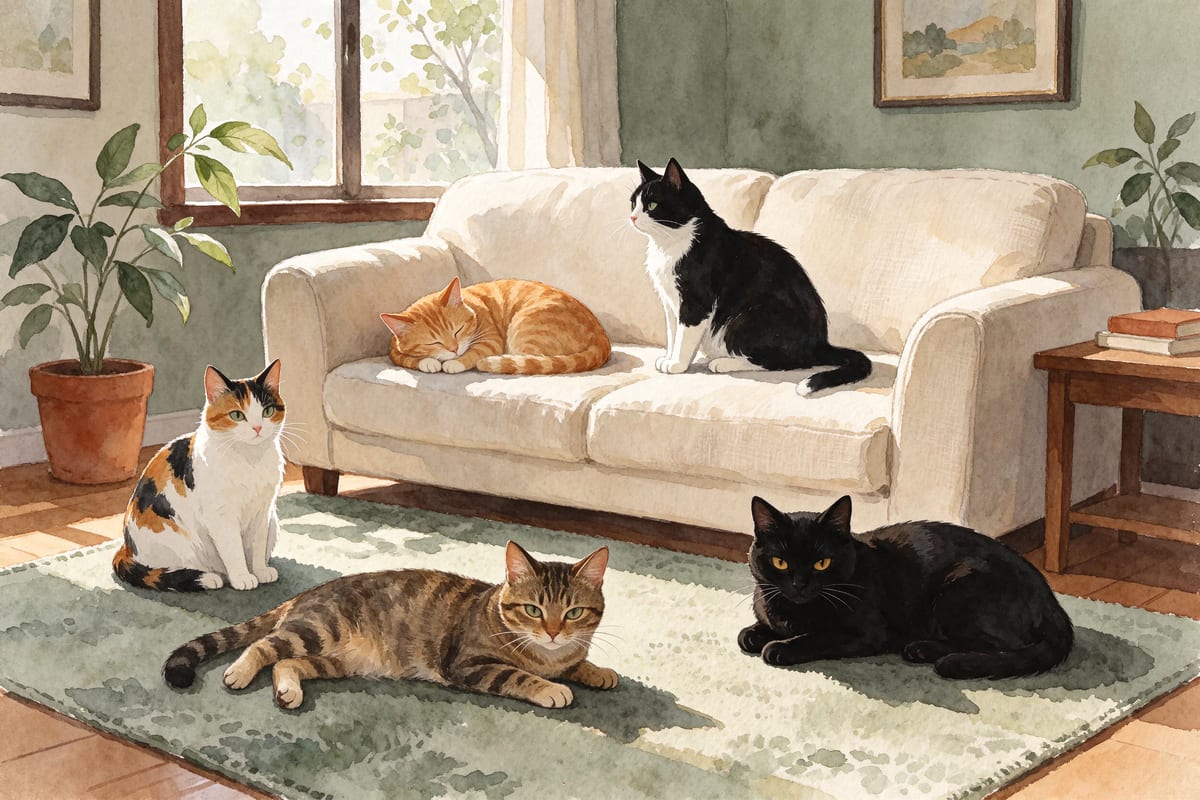
| Coat | What it is | Genetics and sex | Popular belief | What the evidence shows |
|---|---|---|---|---|
| Calico | White with patches of orange and black | Almost always female | Independent, strong-willed | Owners rated slightly more aggression in one survey; differences small |
| Tortoiseshell | Mottled orange and black, little or no white | Almost always female | “Tortitude”, feisty | Same survey as calico; weak, owner-reported evidence |
| Brown or grey tabby | Stripes, swirls or spots with an “M” on the forehead | Both sexes | Easy-going | No study separates brown from grey tabbies |
| Orange (ginger) | Orange or cream, almost always with tabby markings | Mostly male | Friendly, affectionate | A perception, not a measured difference |
| Tuxedo (black and white) | Black with white chest, paws or face | Both sexes | Friendly, clever | Rated as friendly in a perception study; no behavioral evidence |
| Black | Solid black | Both sexes | Mysterious, unlucky | No consistent behavior difference; shelter data are mixed |
| White | Solid white | Both sexes | Aloof, calm | Higher deafness risk with blue eyes |
Genetics: Leaman et al. 1999; Toh et al. 2025; Louisiana State University. Behavior and beliefs: Stelow et al. 2016; Delgado et al. 2012; González-Ramírez and Landero-Hernández 2022.
Why calico and tortoiseshell cats are almost always female
The gene that decides whether fur is orange or black sits on the X chromosome. A female cat has two X chromosomes. If one carries the orange version and the other the black version, each skin cell switches off one X early in development, and the coat becomes a patchwork of orange and black. With white spotting added, that patchwork is a calico; without much white, a tortoiseshell.
In 2025, two research groups identified the change behind orange fur: a small deletion near a gene called ARHGAP36 that shifts pigment cells from black to orange pigment (Toh et al., Current Biology; Kaelin et al., Current Biology). Neither study tested behavior, and the university announcing the Japanese study noted there is no scientific evidence yet linking coat color to personality.
Male calicos and tortoiseshells exist, but they are rare. In a survey of UK veterinary practices, 20 of 4,598 male cats were tortoiseshell, about 0.4% (Leaman et al., Veterinary Record, 1999). Of the 11 males examined in detail, most had a mixture of XX and XY cell lines and two had an extra X chromosome (XXY). Many such males are infertile.
Orange cats are mostly male
Because a cat with one X chromosome needs only one copy of the orange gene, orange coats are much more common in males. In an owner survey of 1,274 cats, 131 of 160 orange or cream tabbies were male, about 82% (Stelow et al., Journal of Applied Animal Welfare Science, 2016). The often-repeated “80%” is roughly right, even if it is rarely sourced.
The orange cat’s reputation for friendliness is mostly a perception. In a study where 189 people rated imagined cats by color, orange cats were described as friendly (Delgado et al., Anthrozoös, 2012). When owners rated their own cats in a later study, orange cats scored highest for friendly and calm, but the differences were not statistically significant (González-Ramírez and Landero-Hernández, Animals, 2022).
Calico and tortoiseshell: the “tortitude” question
The largest survey on color and behavior asked owners about aggression toward people. Owners of tortoiseshell, calico and “torbie” cats, and of some black-and-white and grey-and-white cats, reported aggressive behavior somewhat more often (Stelow et al. 2016). The authors themselves stress the limits: most cats scored close to zero, the differences were small, the sample was self-selected and the answers reflected owners’ impressions rather than observed behavior. That is not enough to describe torties as difficult cats.
Tabby, tuxedo and black cats
Tabby is the most familiar pattern, with stripes, swirls or spots and a classic “M” on the forehead. Brown and grey tabbies are often given different personalities in popular culture, but no study we found separates them.
Tuxedo cats, black with white markings, were rated as friendly in the perception study above, which measured what people expect rather than how cats behave.
Black cats were not rated differently from other colors in that study. Shelter data are mixed. In two Colorado shelters, adult black cats waited longer to be adopted (Kogan et al., Open Veterinary Science Journal, 2013), and a Kentucky study found slightly worse outcomes for black cats (Carini et al., Animals, 2020). In Sydney, by contrast, white cats stayed in the shelter longer than black cats (Miller et al., Animals, 2019).
White cats and deafness
White coats from the dominant white gene are linked to congenital deafness. Older studies summarized by Louisiana State University’s veterinary school found deafness in roughly 65–85% of white cats with two blue eyes, about 40% with one blue eye and 17–22% with no blue eyes. The authors note those samples are old and small. A deaf cat can live a full life indoors; your veterinarian can check hearing and suggest adjustments, such as approaching where your cat can see you.
What actually shapes a cat’s personality
- Breed. In a study of 5,726 Finnish cats, behavior differed between breeds, and heritability estimates for behavior traits were roughly 0.4 to 0.5 (Salonen et al., Scientific Reports, 2019).
- Early life. Kittens weaned before 8 weeks were more likely to show aggression later (Ahola et al., Scientific Reports, 2017). Gentle handling and varied, positive experiences in the first weeks matter.
- Experience and environment. Safe resting places, play and predictable routines shape how relaxed a cat feels at home.
- Health. Pain or illness can change behavior. A sudden change in temperament is a reason to talk to your veterinarian, not a personality trait.
Choosing or getting to know a cat
If you are adopting, spend time with the individual cat and ask the shelter or carer how they behave with people, handling and other animals. If you already live with a cat, watch what they enjoy, what worries them and how they show it. Those observations are a far better guide than the color of their fur.
Frequently asked questions
Does coat color affect a cat’s personality?
Not in any way science has shown clearly. Coat color is linked to sex and to some health traits, but studies of behavior by color are small, rely on owner reports and find small or non-significant differences. Breed, early socialization and experience matter more.
Why are calico and tortoiseshell cats almost always female?
The gene that makes fur orange or black sits on the X chromosome. A cat needs two X chromosomes, one with each version, to show both colors in patches, and most cats with two X chromosomes are female.
Can a male cat be calico or tortoiseshell?
Yes, but it is rare. In a study of UK cats, 20 of 4,598 males were tortoiseshell. Most such males carry extra chromosomes or a mixture of cell lines, and many are infertile.
Are orange cats really friendlier?
People believe so, but the evidence is thin. Orange cats are mostly male, and studies of owner ratings have not shown a reliable difference in friendliness.
Are white cats deaf?
Not all, but white cats carry a higher risk, especially those with two blue eyes. If you share your home with a white cat, ask your veterinarian about checking their hearing.
These articles offer general, everyday guidance. They do not replace advice from a qualified veterinary professional.